
Business systems
The software that runs your operations, instead of spreadsheets and manual steps.
Try the live demo
This is a real, working system for a fictional London wholesaler: orders, inventory, invoicing, live reports. You get your own private copy of the data, so click around and enter anything you want.
Open the live demo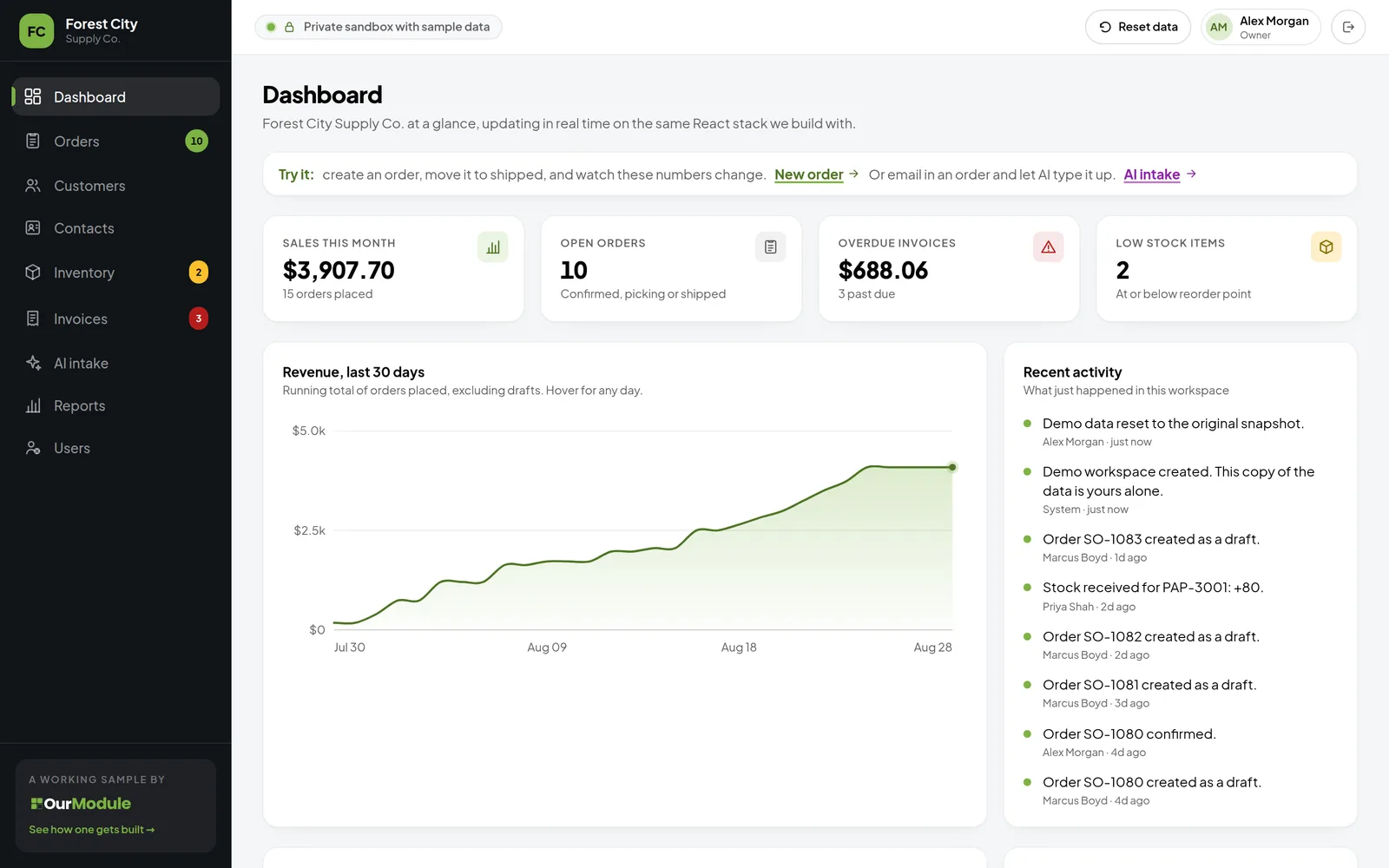
What’s included
When spreadsheets, inboxes, and manual steps start slowing you down, we can replace them with a system built around how your business actually works. You get the pieces you need and nothing you don't.
Online stores and payments
Sell online with secure checkout through Stripe. Cards are handled safely on Stripe's side, payouts land in your own account, and orders are managed in your system.
Product catalogs and carts
Your products, prices, and variations managed in one spot: easy for customers to browse, easy for you to update through your own admin login.
Customer records (CRM)
Every customer, quote, and conversation in one place, so nothing lives only in someone's inbox or memory.
Inventory management
Know what you have, what's running low, and what's on order, without counting by hand or maintaining a fragile spreadsheet. We have even connected inventory systems to barcode scanners for faster, error-free updates.
Invoices and quotes
Create, send, and track them in seconds, with your branding and numbering, tied to the customer they belong to. At CSC LED, one reminder automation we put in place cut overdue receivables from 45% to 9% in a year.
Dashboards and reports
See how the business is doing at a glance: daily sales, open orders, low stock, jobs in progress, top customers, and any other numbers you care about, updated automatically.
Connects to your accounting
The system talks to the accounting software you already use, like QuickBooks, Xero, or Sage, so nothing gets typed twice and the books always match.
Team logins and permissions
Everyone on your team gets their own login, and you control who can see and change what. The warehouse sees orders; only you see the numbers.
Customer accounts and admin dashboards
Customers sign in to see their orders, with one-tap Google sign-in. You get a separate admin dashboard for inventory, calendars, content, and customers.
A real system I built and run
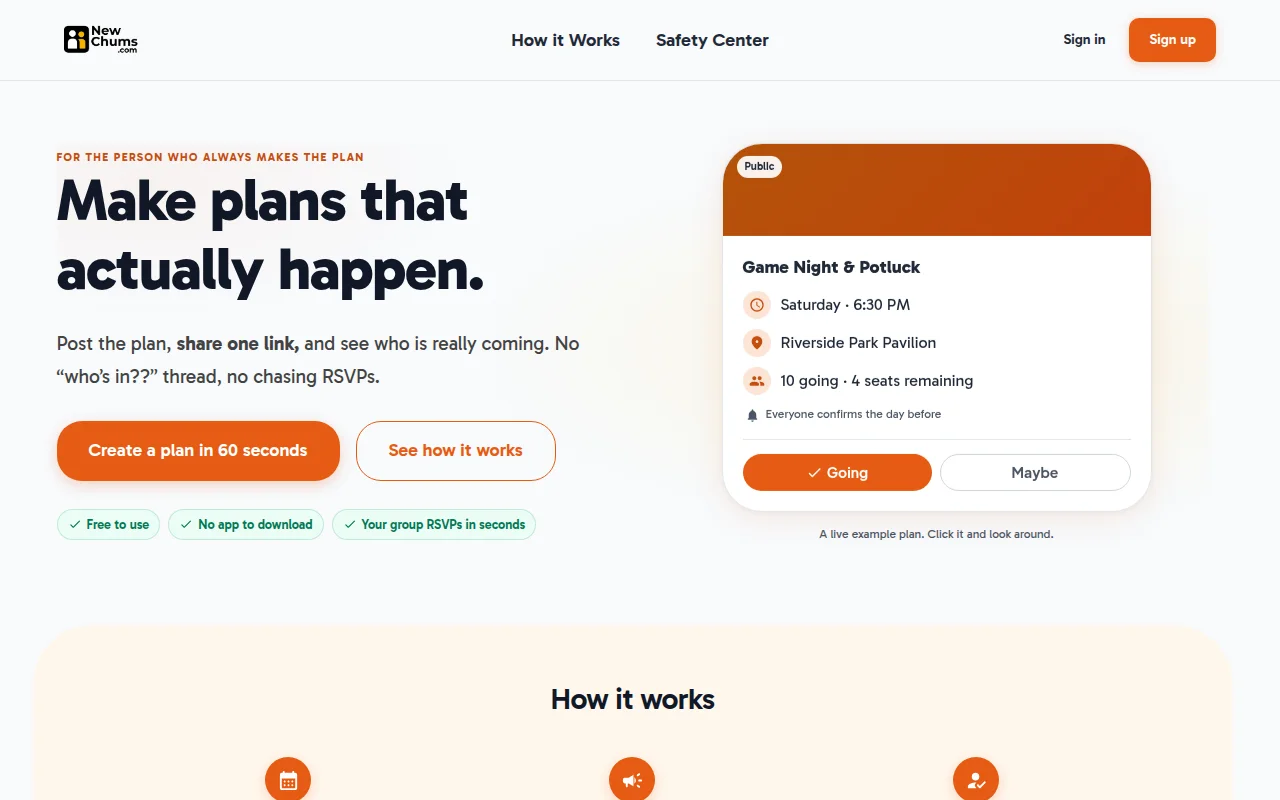
NewChums is a live platform for organizing group plans, and it runs on the same building blocks as the systems on this page.
- Accounts with Google sign-in, roles, and an admin console
- Real-time chat, messaging, and automatic email notifications
- Scheduled jobs that send reminders and process attendance checks every hour
- Its own database, file storage, and hosting, on the stack described below
What it costs to build
Most business systems start around $5,000 CAD, and grow with the modules you need.
How the price works
- The consultation and the solution proposal are always free. If I can't find you a real way to save time or money, you don't pay a cent.
- A well-made module pays for itself: hundreds or even thousands of staff hours saved, fewer mistakes, and more customers won.
- A focused first module, like inventory or customer records, usually lands between $5,000 and $15,000. You start small, prove it works, and add from there.
- At the simpler end, a website with a simple admin login to manage a few details costs little more than the top of the Websites tier.
- You get a fixed quote before any work starts, and it never changes unless you ask for something new and approve the cost first.
- Replacing every system your business uses at once is neither required nor recommended. The system is built to grow module by module.
What it costs to keep running
- Domain name
- $15 to $25 a year
- Your web address, renewed yearly, registered in your name.
- Hosting and database
- $5 to $30 a month
- Systems run on paid hosting and database tiers, because your records need dependable storage and automatic backups.
- Email delivery
- Usually free
- Invoices, reminders, and notifications go out through a trusted delivery service so they reach inboxes reliably. The free tier covers 3,000 messages a month.
- Business email (optional)
- $0 to $10 a month
- Only if you want a professional inbox at your own domain. Google Workspace is the familiar default; Zoho Mail starts near free.
- Payment processing (only if you sell online)
- About 3% per sale
- Stripe's standard rate, taken from each sale before it reaches your account. It goes to Stripe, never to me, and there is no monthly fee.
Everything is paid directly to the providers, in accounts that belong to you, and none of it comes to me. Most systems in this tier run for under $40 a month, and there is no required retainer.
The timeline, step by step
Systems are bigger builds than websites, so most first modules land in 4 to 8 weeks. Here is how it runs.
Step 1: Talk and map the work
3 to 7 daysWe walk through how the work flows today: where things get typed twice, lost, or held up. You get a fixed quote with milestones, and nothing starts until you approve it.
Step 2: Your accounts, your name
about 1 dayAny hosting, database, and email accounts are opened in your business's name before anything is built: by me for you, under a new email address just for your system that I hand to you at launch, or by you with my guide, adding my login. Either way, your records never live in somebody else's account.
Step 3: A first working version
1 to 2 weeksNo mock-ups. I build a slimmed-down, working first version of the module around your real workflow, and we review it together. Expect changes: that is the point of reviewing the real thing.
Step 4: Refine it, use it early
2 to 4 weeksWe review at set stages and I refine it with each round. As soon as it is useful, it goes into your team's hands, so real daily use shapes the final tweaks.
Step 5: Train and switch over
about 1 weekI train your team on real data, we run alongside the old spreadsheets until you trust it, and then we switch. Nothing gets archived until you say so.
Step 6: Handover
about 1 dayIf I opened the accounts, a short call of about 15 minutes hands you the system's email address, and every account comes with it. If you opened them, there is nothing to hand over. My login stays for the thirty days of support after launch, then I leave and confirm in writing that my access has ended. Everything is yours.

The tech stack, with as little jargon as possible
A business system has a few more parts than a website, but the idea is the same. Below is our proposed tech stack: what each part does for you, and the tried-and-tested service I reach for. Already running other tools? No problem, we can work with that too.
The system itself
Custom-coded screens for the way your business actually works, built in React and Node.js, the same technology behind Netflix, Facebook, and Airbnb. No off-the-shelf compromises and no platform limits: if you can describe it, we can build it, and new modules bolt on later without rebuilding.
Database
Where your records live: customers, orders, inventory, invoices. Built on PostgreSQL, the database behind Instagram and Reddit, trusted by banks and hospitals for decades, with automatic backups built in.
Hosting
This is where your ERP and website are hosted. Both live in one place on a global network, which keeps everything fast and simple to maintain.
Hosted onCloudflareSign-in and security
Customers and your team each get their own secure sign-in, with permissions controlling who sees what. That holds whether we build one combined system or a separate ERP and website. Sign in with Google is included, so customers get one-tap access without another password.
Payments
Checkout runs on Stripe, the way most of the internet takes payment: your site tells Stripe what is being bought, Stripe handles the card safely on their side, and reports back what sold. Money lands in your own Stripe account, and card numbers never touch your system.
Processed byStripeEmail delivery
Invoices, overdue reminders, and notifications reach inboxes reliably, instead of vanishing into spam folders. Every email carries your own branding and template, so messages from your system match your site.
Delivered byResendReliability monitoring
An error monitor watches the system around the clock and alerts us if something breaks, often before your team or your customers notice.
Watched bySentryVersion history and backups
Every change to your system's code is tracked and backed up in your own account. Nothing is ever lost, any change can be undone, and any future developer can see exactly how it is built.
Stored onGitHub
Why these services?
Some parts of a system, like payment processing and login security, are too complex, too costly, and too high-stakes to build from scratch. Connecting proven third-party services instead is the industry standard, the same way the world's biggest apps are built.
Proven, not homemade
Services thousands of businesses rely on, not fragile builds from scratch.
In your accounts
Everything signed up under your business name, always in your sight.
Never locked in
We use mainstream tools any developer can pick up. Never tied to me, or to them.
Inexpensive
Even on paid tiers, running costs stay under a typical phone bill.
This is my go-to stack, tried and tested across years of builds, including a company-wide ERP. Already using other tools? I can usually connect to them or work within them.
Is this the right tier for you?
- Your business runs on spreadsheets, inboxes, and memory, and it is starting to hurt
- You are paying three or more monthly subscriptions, often per user, for tools that each do half the job
- The same information gets typed into more than one place
- Hours keep disappearing into tedious, repetitive manual tasks a system could do in seconds
- You want orders, customers, inventory, or jobs in one place your whole team can see
Just need a public website with galleries, forms, and reviews? That is a smaller, faster project: see our Websites tier below. And if the repetitive work is mostly reading, sorting, and drafting, look at AI workflows.
After launch
- You own everything: the code, the accounts, the data. There is nothing to buy back and no required monthly retainer.
- You get plain-language documentation explaining how your system fits together, so you are never lost, and any future developer could pick it up quickly.
- If something I built turns out to have a fault, I fix it, and that is not billable work. Changes to outside services, changes made by others, and new requests get a fixed quote first.
- The system grows with you: new modules bolt on later without rebuilding what already works, always with a fixed quote first.

Yours from launch day
Spend $8,900 once.
Save about $28,500 a year.
A wholesaler shipping eighty orders a day from a printed pick list. Put numbers on the boxes that go out wrong.
Step 1: Today
80
orders shipped a day
Picked and packed by eye from a printed pick list, the way most small warehouses run
Step 2: Wrong shipments
2 in 100
go out with a mistake
A missing line, a wrong size, a swapped box: about 400 wrong shipments a year, each costing roughly $75 in return freight, re-picking, credits, and staff time
Step 3: With scan verification
1 in 1,000
and the packer is stopped on the spot
Every item is scanned against the order before the box closes. A mismatch shows up while it is still on the bench, not at the customer's door
Step 4: Given back
$28,500
a year, in mistakes that never ship
About 380 fewer wrong shipments a year, before counting the customers who never had to call
A verification module like this lands around $8,000 to build, plus about $900 of scanners and $30 a month to run. It pays for itself in about 4 months, then keeps giving back roughly $28,500 a year, and every order that arrives right is a customer who stays one.
An illustration, not a quote. Your numbers depend on your volumes and your error rate. This is a build I have delivered before, so the free consultation can put real numbers on it.
Let's talk about your system
Tell me what is slowing your business down and I'll reply with practical next steps and a fixed quote. The conversation and the proposal are free.
“Robert built the core of the quote module our team has relied on for many years.”
 Alicia Kiedrowski, LC, IESBusiness Development Specialist, CSC LED